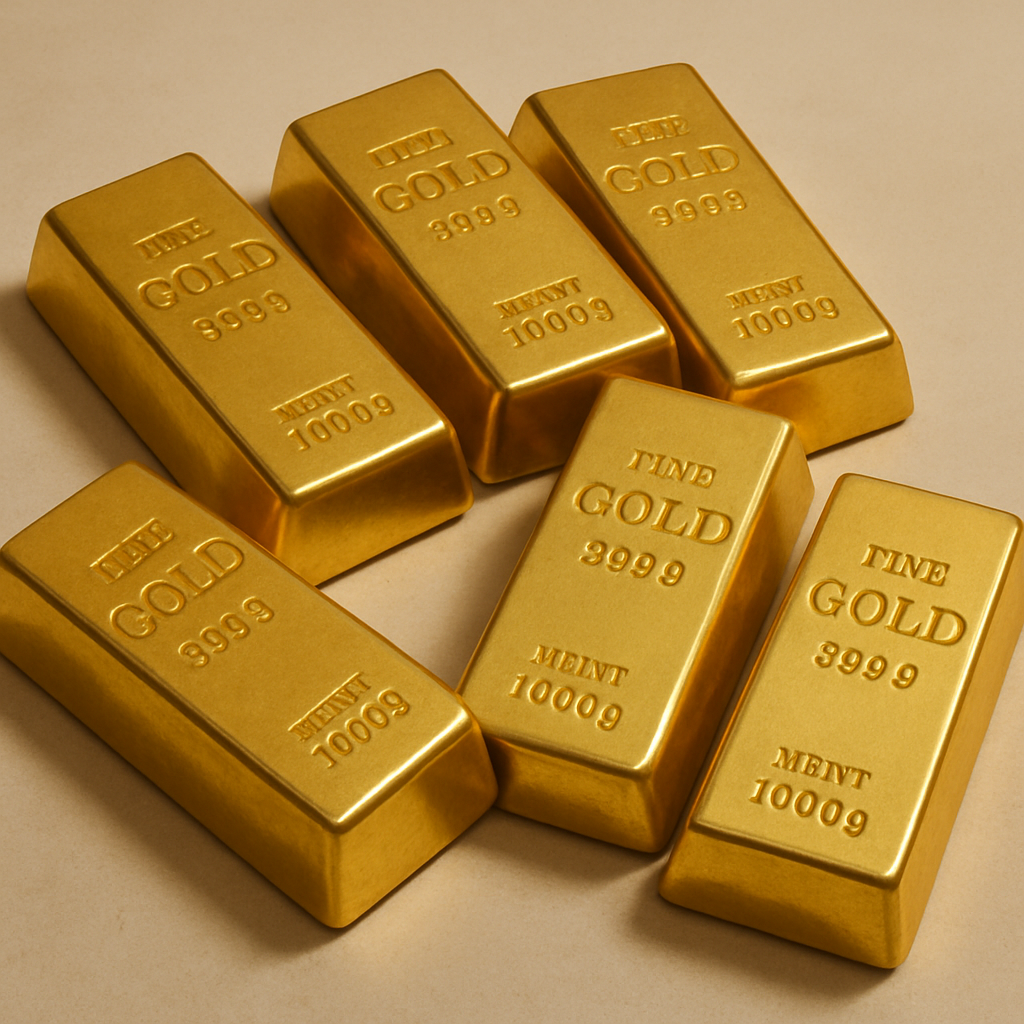
Gold

Gold has always had a way of grabbing attention when the world feels uncertain, but 2026 has taken that to a new level. Bullion has smashed through record after record this year, swung wildly within the same week, and forced even the most conservative Wall Street banks to rewrite their forecasts multiple times over just a few months. If you’ve watched the headlines and wondered whether gold still deserves a place in your financial life or you’re simply trying to understand why your grandmother’s gold bangle suddenly feels like a hot topic at dinner parties guide is for you.
We’ll walk through gold’s long history as a store of value, break down exactly what’s pushing prices around in 2026, look at what major banks and analysts are forecasting, and compare every practical way to buy or invest in gold, from a coin shop to a brokerage account. By the end, you’ll have a clear, grounded picture of where gold stands today and how to think about it going forward.
A quick note before we dive in: this article is for general information and education. It isn’t personalized financial or investment advice, and gold prices can be highly volatile always do your own research or speak with a licensed financial advisor before making investment decisions.
A Brief History of Gold as Money and Wealth
Long before paper currency, stock markets, or cryptocurrency, gold was already doing the job of money. Ancient civilizations in Egypt, Mesopotamia, and Lydia used gold for trade and adornment thousands of years before the first coins were minted. Its appeal was practical as much as symbolic: gold doesn’t rust, tarnish, or decay, it’s easy to divide and reshape, and it’s rare enough that no one could simply manufacture more of it at will.
For centuries, gold underpinned entire monetary systems. The gold standard where paper currency was directly backed by and convertible into a fixed amount of gold governed much of the global economy until the mid-20th century. The United States formally ended the dollar’s convertibility to gold in 1971, ushering in the era of “fiat” currency that we live in today, where money’s value rests on trust in governments and central banks rather than a physical commodity.
You might think that would have made gold irrelevant. It didn’t. If anything, gold’s role simply shifted. Instead of backing currency directly, it became the asset investors and central banks turn to when they start to doubt the value of currency itself a hedge against inflation, a safe harbor during crises, and increasingly, a way for nations to diversify away from reliance on any single country’s money.
Why Gold Still Matters in a Digital Economy
It’s a fair question: in a world of stocks, bonds, real estate, and digital assets, why does a metal dug out of the ground thousands of years ago still command so much attention?
A few reasons keep coming up:
- Scarcity. There’s a finite, slowly growing supply of gold. Mining output can’t be ramped up quickly the way, say, a company can issue more shares.
- No counterparty risk. When you hold physical gold, its value doesn’t depend on a company staying solvent, a bond issuer making payments, or a bank staying open. It’s simply worth what it’s worth.
- A track record spanning millennia. Currencies have collapsed, empires have fallen, and stock markets have crashed — gold has consistently retained purchasing power across all of it.
- Low correlation to stocks and bonds. Gold often behaves differently than traditional financial assets, which is why many portfolio managers use it as a diversification tool rather than a core growth holding.
- A hedge against currency debasement. When governments run large deficits or central banks print money aggressively, gold tends to attract investors worried about the long-term value of paper currency.
None of that means gold is a “safe” investment in the sense of being risk-free — its price can and does swing sharply. But it explains why gold keeps reappearing as a topic whenever inflation ticks up, geopolitical tension rises, or trust in institutions wavers.
Gold Price in 2026: Where Things Stand Right Now
To say 2026 has been an eventful year for gold would be an understatement. After rising 64% in 2025 alone, gold continued its run into the new year, spiking above $5,000 an ounce for the first time in history and eventually touching an all-time intraday high of roughly $5,595 per ounce on January 29, 2026. That peak didn’t last: within days, gold shed close to $1,200 an ounce in one of its sharpest two-day drops since 1983, spooking traders even as most big banks kept raising, rather than lowering, their price targets.
Since then, gold has traded in an unusually wide and volatile range reportedly swinging between roughly $3,960 and $4,850 an ounce during the second quarter alone, with $100–$200 single-session moves becoming almost routine. By mid-2026, prices had settled into what several analysts describe as a consolidation phase, trading in the low-to-mid $4,000s as markets waited for clearer signals from the Federal Reserve and a resolution to lingering geopolitical conflicts, including the drawn-out tension involving Iran and the Strait of Hormuz.
It’s worth putting this in historical context. Gold traded around $1,250 an ounce in 2016. By the end of 2025, it had climbed past $4,300. That’s roughly a 240% gain in under a decade a far steeper climb than gold’s historical norm, and one of the reasons analysts keep debating whether the rally has further to run or is due for a longer pause.
Why the Volatility?
A few forces are colliding at once in 2026:
- A genuinely uncertain macro backdrop. Persistent inflation, a new Federal Reserve chair, and unresolved conflict in the Middle East have all added risk premium to gold.
- A tug-of-war between East and West. Central banks and retail buyers in Asia — particularly China and India — have been aggressively accumulating physical gold, while some Western gold ETFs have seen record outflows in the same period, creating unusual cross-currents in demand.
- Shifting interest rate expectations. Every hint about whether the Fed will cut or hold rates sends gold (which pays no yield of its own) swinging, since higher rates make interest-bearing assets relatively more attractive.
What’s Driving Gold Prices in 2026
Understanding gold’s current run means understanding the handful of structural forces behind it. Here are the biggest ones.
1. Central Bank Buying
For years, central banks around the world have been steadily adding gold to their reserves, and the pace picked up dramatically after 2021 reportedly averaging around 225 tons per quarter between 2021 and 2025, roughly double the rate seen in the preceding five years. In 2026, that pace has cooled on the surface some central banks, including Türkiye, have actually sold gold but reported demand from China has surged, with quarterly imports reportedly tripling and the People’s Bank of China accelerating its own reported purchases.
The strategic logic here matters. When Russian central bank assets held abroad were frozen following the 2022 invasion of Ukraine, it sent a clear signal to reserve managers worldwide: dollar-denominated assets held overseas aren’t unconditionally safe from geopolitical risk or sanctions. Since then, several countries, chief among them China, appear to be steadily building gold reserves as part of a longer-term strategy to reduce their dependence on the U.S. dollar as the world’s reserve currency.
2. Inflation, Interest Rates, and the Dollar
Gold has a long-standing (if imperfect) reputation as an inflation hedge. When the purchasing power of currency erodes, investors often shift capital into assets gold prominently among them — that aren’t tied to any single government’s monetary policy. Heading into the second half of 2026, global inflation has remained elevated, and expectations around the Federal Reserve’s next moves have been a constant source of price swings for gold.
There’s also the “opportunity cost” factor: gold pays no interest or dividend, so when bond yields rise, holding gold becomes relatively less attractive, and vice versa. A weaker U.S. dollar also tends to support gold prices, since gold is priced in dollars globally and becomes cheaper for buyers using other currencies when the dollar falls.
3. Geopolitical Risk
2026 hasn’t been short on geopolitical flashpoints — from the prolonged conflict involving Iran (and its implications for the Strait of Hormuz, through which roughly a fifth of global oil supply passes) to ongoing tension in Europe and instability in parts of South America. Gold has historically been one of the first places investors turn during periods of war, sanctions, or political instability, precisely because it isn’t tied to the fortunes of any single government or economy.
4. Record ETF and Retail Demand
Physical demand for gold — bars, coins, and jewelry — has also been unusually strong in parts of Asia. Global bar and coin demand reportedly rose sharply year-on-year in the first quarter of 2026, with notable increases in mainland China and India. At the same time, gold-backed ETFs (funds that hold physical bullion on behalf of investors) recorded some of their largest annual inflows on record in 2025, even as certain U.S.-listed funds saw outflows during bouts of profit-taking in 2026. Put simply: even when short-term flows have looked mixed, the broader structural demand for gold — from central banks, retail investors, and institutions alike — has remained historically strong.
Gold Price Forecasts: What the Banks Are Saying
If there’s one thing analysts agree on for 2026, it’s that almost nobody predicted how far and how fast gold would run. A widely cited Reuters poll of roughly 30 analysts and traders put the median 2026 forecast at around $4,746 an ounce — the highest annual consensus in that poll’s history going back to 2012, and a striking jump from the roughly $2,700 median forecast made just a year earlier.
Individual bank targets vary widely, reflecting just how uncertain the macro picture remains:
| Institution | 2026 Target (per ounce) | Notes |
|---|---|---|
| J.P. Morgan Global Research | ~$6,000–$6,300 | Cites central bank buying and geopolitical risk |
| Goldman Sachs | ~$4,900 | Lowered from $5,400 on a more hawkish Fed outlook |
| RBC Capital Markets | ~$5,723 | Raised sharply from a prior $4,800 estimate |
| UBS | ~$5,500 | Lowered from $5,900 but remains structurally bullish |
| Morgan Stanley | ~$5,200 | Revised down from $5,700 on elevated real yields |
| Barclays | ~$4,791 | Sees inflation and reserve diversification as supportive |
| ANZ | ~$5,800 | Views gold as an “insurance asset” |
| Yardeni Research | ~$6,000 | Among the most bullish independent forecasts |
(Figures are approximate, gathered from published bank research and financial media coverage current as of mid-2026, and should be treated as illustrative rather than guaranteed outcomes — bank forecasts are revised frequently and none constitute investment advice.)
The World Gold Council, which tends to avoid pinning down a single price target, has instead published scenario-based ranges. In one plausible scenario involving mild economic cooling and falling interest rates, the Council estimates gold could rise a further 5% to 15% from current levels; in a more severe risk-off scenario, the gains could be considerably larger. Looking further out, some analysts project gold could reach the $7,000–$13,000 range by 2030 and 2040 respectively if historical average annual returns hold — though these long-range forecasts carry substantial uncertainty and shouldn’t be treated as reliable predictions.
The key risks that could derail the bullish case, according to multiple analysts, include a more hawkish-than-expected Federal Reserve, a sustained U.S. dollar rally, a genuine de-escalation of geopolitical tensions, and simple profit-taking after such a dramatic run-up. Any one of these could cool the rally; most analysts believe it would take several landing together to reverse it meaningfully.
How to Invest in Gold: 6 Ways Explained
If you’ve decided gold might have a place in your financial plan, the next question is how. There are more options than most people realize, each with its own trade-offs around cost, liquidity, and how much “real” gold ownership you actually get.
1. Physical Bullion: Coins and Bars
This is gold in its most literal form bars and coins you can hold, store, and eventually sell. Coins like the American Gold Eagle, Canadian Maple Leaf, or South African Krugerrand are widely recognised and relatively easy to resell, though they typically carry a higher premium over the “spot price” (the current market price for immediate delivery) than bars do. Bars from accredited refiners tend to carry lower premiums often just 1% to 3% over spot making them more cost-efficient for larger purchases.
The upside of physical gold is total ownership with no counterparty risk: nobody else’s solvency affects what your gold is worth. The downside is practical, you’ll need to think about secure storage (a home safe, a bank deposit box, or a private vaulting service), insurance, and the fact that buying and selling physical metal usually comes with wider spreads and sometimes sales tax, depending on where you live.
2. Gold ETFs (Exchange-Traded Funds)
For most people, a gold ETF is the simplest way to get exposure to gold’s price without dealing with storage or insurance. These funds hold physical bullion in secure vaults and issue shares that trade on stock exchanges just like a regular stock. Well-known examples include SPDR Gold Shares (GLD), iShares Gold Trust (IAU), and SPDR Gold MiniShares (GLDM), each with different expense ratios and levels of liquidity.
The trade-off is that you don’t own the metal directly you own a gold claim held by the fund, along with an annual management fee. For many investors, that’s a fair exchange for the convenience of buying and selling gold exposure in seconds through an existing brokerage account.
3. Gold Mining Stocks
Rather than buying gold itself, you can invest in the companies that mine it. Mining stocks offer leveraged exposure: when gold prices rise, well-run miners’ profit margins — and often their share prices — can rise even faster, since their production costs stay relatively fixed while their revenue climbs. The catch is that you’re now also exposed to company-specific risks: management decisions, operational setbacks, geopolitical risk in mining regions, and broader stock market volatility layered on top of gold’s own price swings.
4. Gold Royalty and Streaming Companies
A less well-known option involves royalty and streaming companies — firms like Franco-Nevada, Royal Gold, and Wheaton Precious Metals — which finance mining operations upfront in exchange for a share of future production or revenue, rather than operating mines themselves. This model can offer some of the upside of mining exposure with somewhat lower operational risk, since these companies aren’t the ones managing day-to-day mining operations.
5. Gold IRAs
In the United States, a Gold IRA is a self-directed individual retirement account that allows you to hold IRS-approved physical gold (along with other precious metals) inside a tax-advantaged retirement structure. It works similarly to a traditional or Roth IRA in terms of tax treatment, but requires a specialized custodian to handle the physical storage and administrative requirements. It’s a popular option for investors who want direct gold ownership specifically within a long-term retirement plan, though fees and rules differ meaningfully from a standard brokerage IRA.
6. Gold Futures and Digital Gold Platforms
More advanced investors sometimes use gold futures contracts to speculate on price movements using leverage — controlling a larger position than their initial capital would otherwise allow. This magnifies both potential gains and potential losses, and it’s generally best suited to experienced traders rather than beginners. On the more accessible end, some platforms now offer “digital gold,” letting you buy fractional ownership of vault-stored bullion priced by value rather than weight — a middle ground between owning physical metal and holding a traditional ETF.
Physical Gold vs. Paper Gold: Which Should You Choose?
There’s no universally “correct” answer here — it depends on why you want gold in the first place.
If your goal is direct ownership with zero counterparty risk, physical bullion is hard to beat, but you’ll take on the responsibility (and cost) of storing and insuring it yourself.
If your goal is simple, low-friction exposure to gold’s price, a physically-backed ETF is usually the more practical choice — no storage headaches, high liquidity, and the ability to buy or sell instantly through a brokerage account, in exchange for an ongoing management fee.
If your goal is long-term, tax-advantaged retirement savings, a Gold IRA lets you combine physical ownership with retirement account tax treatment, though it comes with more paperwork and custodian requirements than a standard brokerage account.
Many experienced investors don’t pick just one. A common approach is holding a core position in physical bullion for direct, long-term ownership, complemented by an ETF or mining stock position for liquidity and flexibility.
How Much Gold Should You Own?
This is one of the most common questions new gold investors ask, and the honest answer is: it depends on your goals, risk tolerance, and existing portfolio. That said, most financial professionals converge on a similar range. Many investing experts suggest limiting gold (and precious metals broadly) to somewhere between 5% and 15% of a total investment portfolio — enough to provide meaningful diversification and downside protection, without sacrificing the long-term growth potential that stocks and other income-generating assets typically provide.
Gold generally isn’t recommended as a primary wealth-building vehicle. It pays no dividend, generates no earnings, and its long-term real returns (after inflation) have historically trailed equities over multi-decade periods. Its value instead lies in what it does for the rest of your portfolio — smoothing out volatility and holding its value during periods when stocks and bonds are both under pressure.
Tips for Buying Physical Gold Safely
If you decide physical gold is the right fit, a few practical guidelines can help you avoid costly mistakes:
- Buy from reputable, established dealers. Look for dealers who are members of recognized industry bodies, such as the London Bullion Market Association (LBMA), which sets quality and ethical sourcing standards.
- Verify purity and authenticity. Legitimate bullion should come with documentation confirming its weight, purity, and authenticity — sometimes called an assay certificate.
- Understand the premium you’re paying. Physical gold always trades above the spot price; the gap (the “premium”) varies by product, dealer, and market conditions. Compare a few dealers before committing to a purchase.
- Plan for storage and insurance from day one. Whether that’s a home safe, a bank safe deposit box, or a professional vaulting service, factor these ongoing costs into your overall return expectations.
- Watch for red flags. The physical gold market is largely unregulated compared to securities markets, so be wary of high-pressure sales tactics, prices significantly below market spot, or dealers unwilling to provide documentation.
Risks of Investing in Gold
Gold’s reputation as a “safe haven” shouldn’t be mistaken for “risk-free.” A few things worth keeping in mind:
- Price volatility. As 2026 has shown vividly, gold can move by hundreds of dollars in a single session, and sharp corrections can follow even the strongest rallies.
- No income generation. Unlike dividend-paying stocks or interest-bearing bonds, gold only pays off through price appreciation — there’s an ongoing opportunity cost to holding it.
- Storage and liquidity considerations for physical gold. Selling large amounts of physical bullion quickly, especially in a stressed market, can be less convenient than selling a stock or ETF.
- Currency and policy sensitivity. Gold’s price is deeply tied to interest rate expectations, dollar strength, and central bank policy — all of which can shift faster than most retail investors can react to.
- Concentration risk. Because gold doesn’t generate cash flow the way businesses do, over-allocating a portfolio to gold can mean missing out on long-term compounding elsewhere.
A Note on Gold and Taxes
Tax treatment is one of the most overlooked parts of gold investing, and it can meaningfully affect your real return. In the United States, physical gold — including coins and bars — is generally classified as a “collectible” by the IRS rather than a standard capital asset. That distinction matters: long-term gains on collectibles held for more than a year can be taxed at a higher maximum rate than long-term gains on stocks or most ETFs. Gold ETFs that hold physical bullion, such as GLD or IAU, are often taxed under this same collectibles rule when held directly in a taxable brokerage account, which surprises many investors who assume ETFs are always taxed like ordinary stock funds.
Gold held inside a Gold IRA follows standard retirement account tax rules instead — either tax-deferred (traditional) or tax-free on qualified withdrawals (Roth) — which is one of the reasons some investors specifically choose that structure for larger, long-term gold positions. Tax rules vary by country and change over time, so this section shouldn’t be treated as tax advice; a qualified tax professional can help you understand exactly how gold gains will be treated in your specific situation.
Frequently Asked Questions About Gold
Is gold a good investment in 2026? Gold has delivered strong returns through 2025 and into 2026, supported by central bank buying, persistent inflation concerns, and geopolitical uncertainty. Whether it’s a “good” investment for you specifically depends on your goals, time horizon, and how much volatility you’re comfortable with — most experts frame gold as a portfolio diversifier rather than a primary growth investment.
What’s the difference between gold spot price and gold premium? The spot price is the current market value of one troy ounce of pure gold for immediate delivery. The premium is the markup that dealers add to cover minting, distribution, and profit margins when selling finished products like coins or bars — jewelry typically carries the highest premium of all.
Can gold prices keep rising, or is a correction likely? Nobody can say for certain. Most major banks maintain bullish forecasts for the remainder of 2026, but nearly all flag risks — a more hawkish Federal Reserve, a stronger dollar, or a genuine cooling of geopolitical tensions — that could trigger a meaningful pullback. Given how sharply gold has already moved this year, continued volatility in either direction should be expected.
Should I buy physical gold or a gold ETF? It depends on your priorities. Physical gold offers direct ownership with no counterparty risk but comes with storage and insurance responsibilities. A gold ETF is far more convenient and liquid but involves an ongoing management fee and doesn’t give you the metal itself.
How much of my portfolio should be in gold? Many financial professionals suggest a range of roughly 5% to 15%, depending on your broader financial goals and risk tolerance. Gold works best as a diversification tool rather than a core holding.
Is a Gold IRA worth it? A Gold IRA can make sense for investors who specifically want physical gold ownership within a tax-advantaged retirement account. It involves more fees and administrative complexity than a standard IRA, so it’s worth comparing custodians carefully before committing.
Final Thoughts
Gold’s 2026 story is really a story about uncertainty — in currencies, in interest rates, in geopolitics, and in how much trust investors and governments place in the existing financial system. That uncertainty has pushed gold to record highs, triggered sharp corrections, and kept nearly every major bank on Wall Street revising its forecasts throughout the year.
None of that changes gold’s fundamental role: it’s not designed to be the engine of your portfolio’s growth, but rather a form of insurance — a way to preserve wealth when other assets falter. Whether you choose a few physical coins, a low-cost ETF, or a dedicated Gold IRA, the same basic principles apply: understand what you’re buying, know the costs involved, size your position sensibly, and treat gold as one piece of a broader, diversified financial plan rather than a bet on any single headline or forecast