Gold Today
Gold today is doing something it hasn’t done in nearly half a century: dominating dinner-table conversations the same way stocks and cryptocurrency once did. Whether you’re a first-time buyer wondering if now is the right moment to invest, a trader glued to the spot price, or a gold seller in Uganda trying to time a sale, one question keeps coming up what is gold doing today, and why?
This guide breaks down where gold today stands in the market, the forces pushing and pulling on its price, what leading banks expect for the rest of 2026 and beyond, and how everyday buyers and sellers including those operating in East Africa’s fast-growing gold trade can make sense of it all.
Where Does Gold Stand Today?
As of early-to-mid July 2026, gold has been trading in a band roughly between $4,100 and $4,200 per troy ounce, after retreating from its all-time high of just under $5,600 set in late January 2026. That correction one of the sharpest of the current bull cycle pulled gold down by close to 20-25% from its peak, yet it still sits far above where it stood a year earlier, when prices were roughly $800 to $900 lower per ounce.
To put that in perspective: gold crossed the psychologically important $3,000 mark in March 2025. Less than twelve months later, it had nearly doubled that milestone. Few assets in modern financial history have moved this fast, this far, in such a short window.
Day to day, gold today moves on a familiar set of triggers:
- U.S. Federal Reserve commentary — every hint about interest rate cuts or hikes ripples straight through the gold market
- The strength of the U.S. dollar — since gold is priced in dollars globally, a weaker dollar tends to lift gold, and a stronger dollar tends to cap it
- Geopolitical flashpoints — renewed military tension in the Middle East and ongoing conflicts in Eastern Europe have repeatedly sent investors into gold as a safe haven
- Inflation data — with U.S. consumer prices running well above the Fed’s 2% target through much of 2026, gold’s role as an inflation hedge has stayed firmly in focus
- Central bank buying — the single biggest structural force behind gold’s multi-year climb
None of these move in isolation, which is exactly why gold today can swing several percentage points in a single week even though the big-picture story hasn’t changed.
A Quick History Lesson: How Gold Got Here
Understanding gold today means understanding how we got here. For most of the 20th century, gold’s price was tightly controlled pegged to the U.S. dollar under the Bretton Woods system. That changed in 1971, when the United States ended the gold standard and let gold trade freely for the first time in decades. Prices spiked through the inflation-plagued 1970s, peaked above $600 an ounce around 1980, and then spent almost two decades drifting sideways, often trading between $300 and $400.
Gold’s modern bull run really began in the 2000s. It surged past $1,900 during the aftermath of the 2008 financial crisis, set a fresh record above $2,000 during the COVID-19 pandemic in 2020, and then embarked on the steepest leg of its climb yet breaking through $3,000 in March 2025 before rocketing to an all-time high near $5,600 in January 2026.
That kind of five-year run appreciating well over 100% while broad stock indices posted solid but far more modest gains is why so many investors, central banks, and everyday savers are asking the same question: is this rally sustainable, or has gold already priced in everything it’s going to?
Why Is Gold Surging? The Five Forces Behind the 2026 Rally
Analysts tracking gold today generally point to five interlocking structural drivers. None of them, on their own, would have been enough to fuel a move this large but together, they’ve created what many strategists are calling a genuine structural bull market rather than a short-term spike.
1. Central Bank Buying at a Historic Pace
For more than a decade, central banks, particularly in emerging markets have been steadily accumulating gold as a way to diversify their reserves away from the U.S. dollar. From 2021 through 2025, central bank gold purchases averaged well over 200 tonnes per quarter, roughly double the pace seen in the late 2010s. China’s central bank, the Reserve Bank of India, Poland’s National Bank, and Turkey’s central bank have consistently ranked among the largest buyers.
This kind of demand behaves differently from typical investor demand. Central banks aren’t trying to time the market or lock in short-term profits they’re building strategic, long-term reserves. That makes their buying relatively insensitive to price, which is a major reason gold has found a firm floor even during sharp pullbacks. It’s also worth noting that a meaningful share of central bank gold purchases go unreported to the IMF, meaning the true scale of official buying may be even larger than published figures suggest.
2. Federal Reserve Policy and Interest Rates
Gold pays no interest or dividend, so its appeal rises and falls with the “opportunity cost” of holding it instead of interest-bearing assets like bonds. When the Fed signals rate cuts, that opportunity cost shrinks and gold tends to rally. When the Fed turns hawkish as it did through much of the first half of 2026, after resilient jobs data and an inflation spike linked to renewed Middle East tensions pushed rate-cut expectations further out gold typically loses some steam.
This single variable explains much of the volatility in gold today. Major banks have repeatedly revised their year-end targets up or down within the same year purely based on shifting expectations about when, or whether, the Fed will start cutting rates again.
3. A Softer U.S. Dollar (With Caveats)
Because gold is priced globally in dollars, a weaker greenback makes gold cheaper for buyers using other currencies, which tends to boost demand and prices. Expectations of a lower neutral interest rate under newer Federal Reserve leadership, along with rising fiscal pressures in the U.S., have added to expectations of a softer dollar over the medium term even though the currency has shown resilience during periods of acute geopolitical stress.
4. Persistent Inflation and Negative Real Rates
Core inflation in the U.S. has remained stubbornly above the Fed’s 2% target through 2026, at times running close to 4%. When inflation outpaces the yield on safe assets like Treasury bonds, “real” interest rates turn negative, historically one of the most reliably bullish conditions for gold. As long as inflation stays sticky, this pillar of the gold bull case remains firmly in place.
5. Geopolitical Risk and the De-Dollarization Trend
Renewed conflict involving Iran and rising tension across the Middle East, alongside ongoing instability in Eastern Europe, has repeatedly driven safe-haven buying in 2026. Layered on top of that is a slower-moving but structurally important trend: a push by BRICS nations and other emerging economies to reduce their dependence on the U.S. dollar as the world’s reserve currency. Gold, which carries no counterparty risk and cannot be frozen, sanctioned, or defaulted on, is a natural beneficiary of that shift.
Who’s Actually Buying Gold Today?
It helps to break demand for gold today into four broad buckets, since each one behaves differently and responds to different triggers.
Central banks (official sector demand). As covered above, this has been the single biggest structural shift in the gold market over the past decade. Central bank purchases crossed the 1,000-tonne mark annually for three consecutive years through 2025, a scale of buying that was almost unheard of in the prior two decades. This demand is largely price-insensitive a finance ministry building strategic reserves isn’t trying to trade around a two-week dip.
Investment demand (ETFs, bars, and coins). This is the most price-sensitive of the four categories and the one that swings hardest with sentiment. When Fed expectations turn dovish or fear spikes, ETF inflows can accelerate quickly; when yields rise and calm returns, outflows follow just as fast. Some of gold’s sharpest short-term moves including the 2026 correction from January’s record high have been amplified by exactly this kind of investment flow reversing direction.
Jewelry and retail demand. Concentrated heavily in India, China, the Middle East, and East Africa, this demand tends to be more cultural and seasonal driven by weddings, festivals, and gifting traditions and is somewhat price-elastic: when gold today gets expensive enough, retail buyers often delay purchases or opt for lower-purity items, and demand picks back up once prices stabilize.
Industrial and technology demand. A smaller slice of the overall market, used in electronics, dentistry, and other applications, this segment is the least influential on price but adds a steady baseline of demand regardless of where gold today happens to be trading.
Understanding which of these four groups is driving a particular price move matters, because a rally led by central banks tends to be far more durable than one led purely by short-term investment flows chasing momentum.
Gold Price Forecasts: What Do the Banks Expect Next?
If there’s one thing every major bank agrees on, it’s that gold today is trading well below where most of them expect it to finish the year. Forecasts have moved around considerably through 2026 as Fed expectations shifted, but as of mid-2026, the general landscape looks roughly like this:
| Institution | Year-End 2026 Target (approx.) |
|---|---|
| Goldman Sachs | ~$4,900/oz |
| Morgan Stanley | ~$5,200/oz |
| UBS | ~$5,500/oz |
| J.P. Morgan | $6,000–$6,300/oz |
| Wells Fargo Investment Institute | $6,100–$6,300/oz |
| Bank of America | ~$6,000/oz (up to $8,000 in an extreme-demand scenario by 2027) |
| Société Générale | ~$6,000/oz |
Even the more conservative forecasts on this list sit meaningfully above where gold today is actually trading, which means every major bank is effectively calling for further upside by year-end they simply disagree on how much. The World Gold Council, which tends to avoid pinning down a single number, instead frames 2026 in terms of scenarios: a mild economic slowdown paired with falling interest rates could lift gold by 5-15%, while a resilient U.S. economy with rising yields could see prices soften instead.
It’s worth being clear-eyed about why these targets keep shifting. Every time the Fed’s rate-cut timeline gets pushed back, banks like Goldman Sachs trim their targets. Every time incoming data reopens the door to easier policy, targets get revised upward again. That tug-of-war is precisely why gold today can feel so unpredictable in the short term even while the long-term structural story remains intact.
Spot Price vs. Futures Price: Know the Difference
If you’re following gold today closely, you’ll come across two different numbers the spot price and the futures price and it’s worth knowing the difference before you buy or sell anything.
The spot price is the price for immediate delivery and settlement essentially, what gold is worth right now, this minute, in an over-the-counter trade. It’s the number most news outlets quote when they say “gold is trading at $X today.”
The futures price reflects an agreed price for gold to be delivered at a set date in the future, and it typically trades on exchanges like COMEX. Futures prices can diverge slightly from spot prices based on storage costs, interest rates, and market expectations, but the two generally track each other closely.
There’s also the bid-ask spread to keep in mind the gap between what a dealer will pay you to buy your gold (the bid) and what they’ll charge you to sell it to you (the ask). A tighter spread generally signals a more liquid, competitive market; a wider spread can eat meaningfully into returns, especially for smaller transactions or less standardized items like jewelry.
Gold Today and the East African Trade Boom
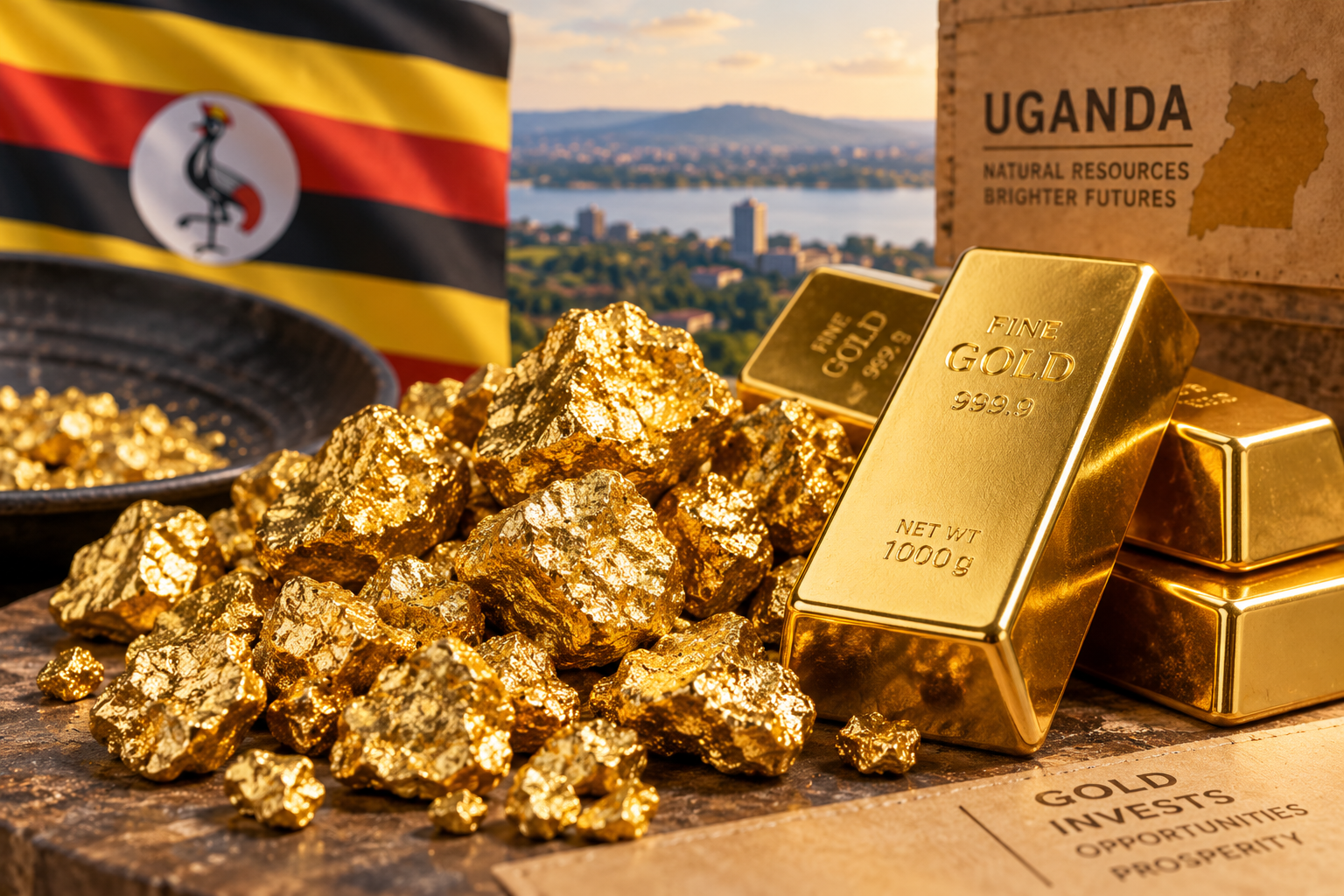
While Wall Street headlines focus on futures contracts and Fed meetings, gold today is having just as significant an impact several thousand miles away in the mining pits, trading floors, and export corridors of East Africa. Uganda, in particular, has emerged as one of the region’s most closely watched gold markets, positioned as both a producer and a regional trading and refining hub for gold moving out of the Great Lakes region.
Rising global prices have had a direct, tangible effect on this trade in several ways:
Higher incentives for artisanal and small-scale mining. As the price per gram climbs alongside the global spot price, small-scale miners across Uganda and neighboring countries have more incentive to bring gold to market, increasing the volume moving through licensed buying, refining, and export channels.
Greater scrutiny on provenance and purity. With prices this high, the financial stakes of getting a transaction wrong whether through mislabeled purity, diluted alloys, or unclear chain-of-custody documentation have never been greater. Buyers and exporters are leaning more heavily on assaying, certification, and traceable logistics to protect themselves.
A bigger role for secure logistics and export handling. Moving physical gold whether as bars, nuggets, or dust from mine sites to buyers, refiners, and international markets requires far more than a standard freight shipment. It calls for secure transport, proper customs documentation, verified weighing and assaying, and compliant export licensing, particularly given Uganda’s role as a transit and refining point for gold originating from across the region.
For anyone buying, selling, or exporting gold out of Uganda or the wider East African market, gold today isn’t just a number on a financial ticker it’s a live input into pricing negotiations, mining economics, and logistics planning, often changing by the hour.
There’s also a wider regional story worth noting. Uganda has increasingly positioned itself as a refining and re-export hub for gold originating from the Democratic Republic of Congo and other neighboring producers, alongside its own domestic output. That role brings real economic opportunity refining, certification, and export services all add value before gold leaves the region but it also brings added responsibility. International buyers and regulators pay close attention to where gold was actually mined, how it was transported, and whether it changed hands through properly licensed dealers. As gold today trades at levels that make even small shipments extremely valuable, the margin for error on documentation and traceability has shrunk to almost nothing. A single missing certificate or an unverifiable chain of custody can hold up a shipment for weeks or knock a meaningful percentage off the price a seller ultimately receives.
This is precisely why buyers, miners, and exporters across the region increasingly rely on specialized logistics and mineral consultancy partners rather than handling gold shipments the way they would any other cargo. Getting gold from a mine site in western or northeastern Uganda to a certified refiner, and then on to an international buyer, typically involves several tightly coordinated steps: independent assaying to confirm weight and purity, secure and insured transport, correct customs classification and export licensing, and clear documentation at every handoff point. Skipping or rushing any one of these steps is where most costly disputes and delays originate.
How to Invest in Gold Today: Six Common Approaches
For those looking to add gold exposure to a portfolio, there’s no single “right” way to do it the best approach depends on your goals, budget, and appetite for handling physical assets.
1. Physical bullion (bars and coins). The most direct way to own gold. You get tangible ownership with no counterparty risk, but you’ll need to think about secure storage, insurance, and eventual resale.
2. Gold ETFs. Exchange-traded funds that track the gold price offer easy, liquid exposure without the hassle of storing physical metal. Some ETFs hold physical bullion in vaults; others invest in shares of gold mining companies, which can add exposure to company-specific risks and rewards on top of the metal’s price movements.
3. Gold IRAs. A way to hold physical gold within a tax-advantaged retirement account. These come with setup fees, storage fees, and annual administration costs, so it’s worth comparing providers carefully and remembering that, unlike stocks or bonds, this asset generates no dividends or interest; it only grows if the gold price itself rises.
4. Gold mining stocks and funds. Buying shares in companies that mine gold offers leveraged exposure to the gold price, but also brings in operational, management, and geopolitical risks tied to the specific company or region.
5. Jewelry. A popular route in many markets, including much of East Africa and South Asia, though buyers should be aware that retail markups, craftsmanship costs, and purity variations mean jewelry rarely tracks the spot price cleanly as an investment.
6. Gold ore, dust, and nuggets. Common in producing regions, these forms require careful assaying and verified purity documentation before any transaction, since value depends heavily on confirmed gold content rather than weight alone.
Financial advisors are divided on how much of a portfolio should sit in gold. Historical analysis from several strategists points to allocations somewhere in the 5% to 15% range for investors seeking diversification and a hedge against economic uncertainty, though some recommend far less or none at all depending on individual risk tolerance and time horizon.
Risks Worth Weighing Before You Buy
Gold today’s strong run doesn’t mean it’s risk-free. A few things worth keeping in mind:
- Volatility cuts both ways. The same forces that pushed gold up more than 25% from its January 2026 peak can reverse quickly if the Fed turns more hawkish, the dollar strengthens, or geopolitical tensions ease.
- No income generation. Unlike dividend stocks or interest-bearing bonds, gold only pays off through price appreciation.
- Opportunity cost. In a strong, low-inflation economy, equities have historically outperformed gold over long stretches — since 1971, stocks have averaged noticeably higher annual returns than gold, even though gold has closed the gap dramatically over just the past few years.
- Storage, insurance, and liquidity costs for physical gold can quietly erode returns if not planned for.
- Purity and provenance risk, particularly for buyers of gold ore, dust, nuggets, or jewelry rather than standardised bullion, where independent verification matters enormously.
- Timing risk after a big run-up. Gold today has already delivered outsized gains over the past two years, and buying purely because prices are rising rather than because gold fits a specific portfolio goal is a common way investors end up disappointed by a subsequent pullback.
None of this means gold today is a poor choice for every investor. It simply means gold works best as one deliberate piece of a broader financial plan rather than a reactive bet placed because prices happen to be in the headlines.
Buying or Selling Gold Safely: A Practical Checklist
Whether you’re a retail investor purchasing your first coin or a trader handling shipments of gold bars, dust, or nuggets, a few practices consistently separate safe transactions from costly mistakes:
- Verify purity independently. Insist on certified assaying from a reputable, accredited source before finalizing any purchase or sale, especially for ore, dust, or nuggets where visual inspection alone tells you very little.
- Confirm today’s actual spot price before negotiating. Gold today can move meaningfully within a single trading session — always check a live, reliable source immediately before agreeing on a price.
- Understand the spread you’re being offered. Ask directly what the buying and selling prices are and how they compare to the live spot price; a wide, unexplained gap is a red flag.
- Work with licensed, properly documented buyers, sellers, and logistics partners. In cross-border trade especially, proper export licensing, customs documentation, and secure chain-of-custody handling protect both sides of a transaction.
- Get everything in writing. Weight, purity, price basis, and delivery terms should all be documented before gold changes hands.
- Factor in secure transport from the outset. Physical gold moving between mine sites, buyers, refiners, and export points needs professional, insured, and properly permitted logistics — not an afterthought bolted on at the last minute.
Frequently Asked Questions About Gold Today
What is the price of gold today? Gold has been trading roughly between $4,100 and $4,200 per troy ounce in early-to-mid July 2026, down from its all-time high of nearly $5,600 set in late January 2026 but still substantially higher than a year earlier. Because prices shift throughout each trading session, it’s always worth checking a live, reputable source immediately before any transaction.
Why did gold prices fall from their January 2026 high? The pullback was driven mainly by a combination of stronger-than-expected U.S. jobs data and an oil-driven inflation shock, both of which pushed back market expectations for Federal Reserve rate cuts. Since gold pays no yield, higher-for-longer interest rates increase the opportunity cost of holding it, which weighed on prices even though the longer-term structural drivers stayed intact.
Will gold keep rising in 2026? Most major banks expect further gains by year-end, with published targets ranging from roughly $4,900 to over $6,000 per ounce, though forecasts vary widely and have already been revised multiple times this year as Fed policy expectations shift. The direction of U.S. interest rates, the strength of the dollar, and the pace of central bank buying remain the biggest swing factors.
Is gold a good investment right now? That depends entirely on your goals, time horizon, and risk tolerance. Gold has historically served as a hedge against inflation and market turmoil rather than a guaranteed high-growth asset, and many advisors suggest limiting gold to a modest slice of a diversified portfolio rather than concentrating heavily in it.
What’s driving central banks to keep buying gold? Central banks, particularly across emerging markets, have been diversifying reserves away from the U.S. dollar for over a decade, and gold — with no counterparty risk and no dependence on any single government — fits that goal well. This buying has been relatively steady even during price corrections, providing a structural floor under the market.
How is gold today affecting Uganda’s gold trade? Higher global prices have increased incentives for small-scale mining and boosted the volume of gold moving through licensed buying, assaying, and export channels in Uganda and the wider East African region, while also raising the stakes around verified purity, documentation, and secure logistics for every transaction.
The Bottom Line
Gold today sits at a genuinely interesting crossroads. It has already delivered one of the strongest multi-year rallies in its modern history, corrected sharply from a record high, and is now trading well below where most major banks expect it to land by the end of 2026. The structural forces behind the move — persistent central bank buying, sticky inflation, geopolitical uncertainty, and a slow but real shift away from dollar dependence — haven’t disappeared; they’ve simply been fighting it out with a more cautious Federal Reserve in the short term.
For investors, that means treating gold the way most seasoned strategists do: as a long-term store of value and portfolio diversifier, not a guaranteed short-term trade. For miners, buyers, and exporters across Uganda and East Africa, it means the fundamentals of the business haven’t changed — verify purity, confirm the live price, document everything, and move physical gold through secure, properly licensed logistics channels.
Whichever side of the transaction you’re on, one habit matters more than any other: check where gold today actually stands before you buy, sell, or ship because in a market this dynamic, yesterday’s price is already history